I figured it was about time I put some long-term goals into place, writing wise. I've always found deadlines liberating, and the purpose of posting them here?
Anyone reading this blog post is a witness. Feel free to hold me to it.
November 23: finish first draft of Surgeburnt
December 1: finish editing on Unnatural Causes, synopsis (waaaah I don't wanna) and query (nooooo)
January 1, 2018: start next novel (writing phase)
Note that these dates are all deliberately before the holidays, with the exception of the last, because I expect to be madly, ridiculously, eye-crossingly busy during the Christmas season.
In my family, we refer the "drop-deadline" - that is, the time by which something absolutely, positively has to be done to avoid dire consequences. (Use this term sparingly, as it has been known to cause the uninitiated to crack up laughing.)
So for the first goal posts, if I don't make them, the drop-deadline is the first of the year.
Let's get cracking. Or rather, typing.
About Me

- Lindsey Duncan
- I'm a professional harp performer, chef / pastry chef, and speculative fiction writer from Cincinnati, Ohio. My contemporary fantasy novel Flow is available from Double Dragon Publishing, and my science fiction novel Scylla and Charybdis is now out from Grimbold Books. I've also sold a number of short stories and a few pieces of speculative poetry. I write predominantly fantasy, usually epic and/or humorous, with some soft science fiction. I play the traditional lever harp with a specialty in Celtic music - but I also perform modern and Renaissance tunes. And yes, you read that right - I have a diploma in Baking and Pastry and an Associates in Culinary Arts and am currently working in the catering field at Kate's Catering and Personal Chef Services (Dayton, KY). I am a CPC (Certified Pastry Culinarian) and CSW (Certified Specialist of Wine).
Thursday, August 10, 2017

Sunday, August 06, 2017
Song Styles
So I spent the last two weeks doing a self-imposed Boot Camp, writing a flash or poetry piece a day from a list of prompts I collected / generated. My prompt from Day 12 was "She watched the bloodstained dress burn." (Not necessarily to incorporate the sentence verbatim, but the concept / beat.)
But another thread of inspiration popped into my head to drive this particular story:
Cry To The Beat Of The Band - Sophie Ellis-Bextor
Yes, this from Wanderlust, which I've described before as one step away from being a fantasy concept album. This is probably one of the *least* overtly fantastical songs on the album.
Monday, July 31, 2017
Monday Meanderings
Outside the realm of fantasy, the Prologue is a perfectly acceptable way to foreshadow, show an unrelated or only partially related event that sets the scene, or otherwise provide a frame for the book to follow.
Inside the realm of fantasy, the Prologue is the source of a veritable firestorm of controversy, with some readers swearing they never read them and writers warning each other that it means an agent will instantly pitch their book; and others simply treating them as a valid storytelling tool.
There's a reason for the grumbling within the fantasy community: in older fiction (and still by newbie writers), the Prologue is often used for worldbuilding, and ends up an excuse for creation myths and other elements that more properly ought to be woven into the story gradually and organically. But it doesn't have to be.
Personally, I don't use Prologues too often, not because I have anything against them, but because I'm not a big fan of chapters, either. Ironically, both my published / forthcoming works use chapters, but I flailed and threw things and regretted it the whole time.
On the other hand, I can't comprehend not reading part of a book just because of its label. I'm a completionist.
Prologues work best when they're used to provide a snapshot of events outside the story, not a summary but a scene that may even seem out of context until later in the main tale. If it belongs in a guidebook ... it's not your prologue.
Word Count this week: 8,942
Poems written: 2 (I am counting poems separately / not inclusively)
Pages edited: 5.5
Sunday, July 30, 2017
Song Styles
Thanks to a fellow harper, I have a beautiful new early music tune to work on, a Middle English song entitled "Byrd One Brere" - according to her, the first known love song. Here's the Mediaevel Baebes' take on it:
Byrd One Brere
Gorgeous, haunting, and unexpected. These earlier tunes often have patterns and conventions that don't match what we're used to hearing, so they seem to go in strange directions. I'm not even taking the tired trope that "modern music is dull and repetitive" - this is more fundamental. Conventions and paradigms in music have shifted over the years (and cultures) and this is a prime example.
Monday, July 24, 2017
Monday Meanderings
A few months ago, the organizers for my harp group (which believe me when I say it is like herding cats) met to discuss repertoire. We also exchanged music. One harper offered a packet of Irish hymns and mentioned, "They're all pretty easy."
Said I, tongue in cheek, "Oh, well, I'm less interested now."
A blank and puzzled stare in answer.
"Come on," I added, "you know I'm a musical masochist."
And I was only partly joking. I find that "easy" tunes often don't have enough interest for either my ears or my fingers. When I come across a melody that intrigues me, but has a tricky section - hard to finger, sequence of accidentals - I tend to be more determined to play it. If there's a specific left hand sound I want, I will keep pushing until I make it work.
This tends to be how I am with most creative endeavors: I'm drawn to difficulty. Long before I ever cooked professionally, my earliest recipe attempts quickly got more ambitious than my skill level could handle. One of my favorite short story idea tactics is to take two very disparate ideas and fit them together. And I love the beginning parts of a new work: figuring out how to introduce the elements of character, setting and a plot in a short span is one of my favorite things to do. It's like a puzzle.
I'll admit: sometimes I bite off more than I can chew. I spend more time working on a single tune / dish / project, and it may not always be a worthwhile tradeoff. (I've thrown out some recipes because they were good, but not that-level-of-effort good.) Often, what people want is the simpler stuff that I've skipped over. I find a lot of the "classic" Celtic tunes unappealing because they've been so played to death.
But my hyper little brain loves a challenge. It's just how I'm wired. Which is probably why I love form poetry so much, because it is such a bear to work with ...
Word Count this week: 6,534
Pages edited: 7 (1.5 of these edited twice)
Poems edited: 1 (twice)
Sunday, July 23, 2017
Song Styles
So a long time ago, I wrote a story to a prompt from the wonderful The 3am Epiphany (Kiteley, highly recommended for an author of any genre) to write about an article of clothing. The resultant story took just a smidge of inspiration from this song, down to the title:
In These Shoes? - Kirsty MacColl
Sans the question mark, as far as the story was concerned ... because for Rosh, they were her killing shoes.
This song was also my introduction to the inimitable Kirsty MacColl. It comes from Tropical Brainstorm, her final album before her untimely death.
An amusing aside (at least to me): "The One And Only" from Electric Landlady has an instrumental interlude that was driving me bonkers with how familiar it sounded. I finally pegged it: Planxty Irwin, a traditional Irish tune from the prolific blind harper, Turlough O'Carolan.
GoodReads Review: The Serpent's Tale by Ariana Franklin
(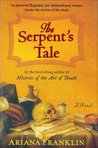 The Serpent's Tale by Ariana Franklin
My rating: 4 of 5 stars
Murder, mayhem, rebellion and forbidden romance clash in medieval England, dragging the clear-eyed, analytical Adelia Aguilar into their midst. Adelia is what we would call a forensic doctor, trained in Salerno, and her every move is complicated by the fact that -in England - women have no medical knowledge and virtually no rights.
This storyline is a powerful river, sweeping everything along in its wake. It is Adelia's sharp curiosity that keeps form in the narrative, propelling forward in mind even when circumstances prevent her from directly confronting the mystery at hand. The period details are stellar and (usually) seamlessly integrated into the narrative. Her push-me-pull-you relationship with Rowley is compelling, and not your typical romance subplot.
To some extent, the other elements overcome the mystery in this book: there was a place at which I felt that the mystery was kind of besides the point. But then a final surprise brought me back to the mystery storyline. Recommended.
View all my reviews
(No, this is not spec-fic, but it's in a period which inspires a lot of fantasy work, and it's a great read for history and/or mystery fans.)
The Serpent's Tale by Ariana FranklinMy rating: 4 of 5 stars
Murder, mayhem, rebellion and forbidden romance clash in medieval England, dragging the clear-eyed, analytical Adelia Aguilar into their midst. Adelia is what we would call a forensic doctor, trained in Salerno, and her every move is complicated by the fact that -in England - women have no medical knowledge and virtually no rights.
This storyline is a powerful river, sweeping everything along in its wake. It is Adelia's sharp curiosity that keeps form in the narrative, propelling forward in mind even when circumstances prevent her from directly confronting the mystery at hand. The period details are stellar and (usually) seamlessly integrated into the narrative. Her push-me-pull-you relationship with Rowley is compelling, and not your typical romance subplot.
To some extent, the other elements overcome the mystery in this book: there was a place at which I felt that the mystery was kind of besides the point. But then a final surprise brought me back to the mystery storyline. Recommended.
View all my reviews
(No, this is not spec-fic, but it's in a period which inspires a lot of fantasy work, and it's a great read for history and/or mystery fans.)
Monday, July 17, 2017
Monday Meanderings
Today, I want to talk about a character trope that particularly annoys me, one you see nigh-constantly in television media: the genius is an a*****e. I'll use the term jerk from here on out to avoid having to self-censor myself, but really: what I mean is precisely what I said.
There seems to be a compulsion to present characters who are brilliant problem solvers, scientists, innovators, as genuinely obnoxious people to be around: misanthropes, smart alecks, bucking authority not because it needs to be bucked, but simply because they can't stand rules. Television in particular adores this trope: House, Sherlock in Elementary, and most recently, how Genius portrayed Albert Einstein. Now, I know enough about Einstein to know that's a somewhat accurate portrayal, but it really was emphasized to a grating extent. I also just tried out Amazon Prime's The Collection, and lo and behold, there's another cynical, misanthropic genius. (Claude also suffers from a second trope that I hate - and suffer is exactly the right word - but that's for later in this post.)
To some degree, it's easy to see why television in particular reaches for this trope. It's an easy flaw to give a character who otherwise has unfair advantages without having to alter the storyline or the opposition. It's a flaw that is readily visible and creates outward conflict. And you do see it in literature, too. Dr. Frankenstein comes to mind, but I would say it's less common because it's easier to show inner flaws and struggles in fiction, where you can get deep into a character's head. It's also very possible that I don't have many examples from literature because I tend to avoid reading about those types of characters. Spoiler alert: I don't enjoy it.
I also think that genius-as-jerk is wish fulfillment. Don't we all wish we were smart enough / good enough at our jobs that we could ignore human conventions and have people kowtow to us? Sadly, that's rarely the way the world works, but it's part of the attraction of the trope. And there certainly is an argument that the genuinely brilliant often have trouble interfacing with society's rules, so portraying characters that way is realistic.
On the other hand, it doesn't have to be that way. The one-season television show Allegiance portrayed a remarkably brilliant young man who had trouble interacting with people, but it wasn't the attitude of a jerk or misanthrope; he simply had trouble reading cues and was intensely shy. (This character was also autistic, and the intriguing thing about it was that one could tell, but it was never stated outright.) In the fictional realm, take Miles Vorkosigan, whose intellect gets him into trouble ... quite beyond his physical flaws, which are another issue entirely.
The genius-as-jerk trope has a close connection with another character trope that drives me batty, the tortured artist. (Remember Claude from The Collection? He is a perhaps painfully perfect illustration of this.) Maybe it comes back to the wish fulfillment, and we writers would love everyone to bow to us even as we suffer for our art, but the tortured artist is difficult, surly, and has a dysfunctional relationship with his muse ... but his product is astounding, so everyone around him puts up with it.
Maybe this was a bit more true in earlier generations, but these days, the whiny or unproductive artist doesn't get concessions; they get the boot. There's always someone just as talented who *isn't* difficult. I really think this trope is harmful to newcomers, too: young writers and artists may think that the world is going to treat them like the artists in film (and sometimes fiction), and it's a shock to find out otherwise.
In my own works, both Vil (narrator of Unnatural Causes) and Iluenn, her "sidekick," are highly intelligent, but they have compensating flaws: Vil her inexperience with human foibles and politics, and Iluenn her (crushing lack of) self-confidence. Now, I'll confess that Maren from Surgeburnt *is* a jerk (you'd probably want to punch her if you met her), but she takes just as many shots at herself, and she's not unusually intelligent.
If I ever tackle the tortured artist trope without subverting it in some way, shoot me in the head.
Word Count this week: 5,309
Pages Edited: 7.5
Sunday, July 16, 2017
Song Styles
Unnatural Causes is off to readers ... heaven help me (and them).
So for today, here's the song I have written down as a touchstone on the overarching theme. If you listen to the lyrics, they refer specifically to a romance, but they have much broader implications, especially for a tale with politics, betrayal and a dose of hero worship:
Writing On The Wall - Blackmore's Night
I've also written a short story that uses this song as a tighter theme / inspiration, along with another tune that just happens to be part of my Unnatural Causes soundtrack. I've referenced this one before, and it's Vil's themesong, as well:
Orange Express - Miami Sound Machine
To repeat: "a toda maquina" means "at full speed" or "full speed ahead."
Monday, July 10, 2017
Monday Meanderings
I'm a goal-oriented person: I do best when I have something concrete to work towards, and I find deadlines motivating. I often impose structure on myself; even internal accountability helps me work. I've participated in groups where everyone sets weekly goals, and I love that framework. Others may like the sensation of having a cheering section, or be motivated away from the guilt of having to report failure. For me, the motivating part is setting it down in concrete words (in front of witnesses is a bonus; it keeps me honest with myself). I don't always meet my goals, but when I don't, I've made a conscious choice that my priorities need to go elsewhere. Having a specific goal, as opposed to, "as much as possible," actually, for me, makes me feel more free to adjust when necessary.
Also, I just really like numbers. It's a bit of a disease, really. I like tracking and percentages and totals. I like measurements. (This is a good thing for a pastry chef, really.)
I'm not quite ready to add personal writing goals to my plate right now; I have a lot of balls in the air presently. But what I am going to start doing is tracking, so I can get a feel for how much I'm getting done per day (and probably be highly embarrassed by it). That may also give me an idea of what a reasonable weekly goal might be ...
See what I mean? I'm setting goals for the purpose of figuring out what goals I should set.
Sunday, July 09, 2017
Song Styles
I'm in the final pages of this editing pass of Unnatural Causes, and then I'll be looking for beta readers ... my first serious use of beta reading, well, ever. I used to have my childhood best friend read my novels, and she was wonderful at picking out grammatical issues - I probably have her to partially thank for my keen eye ... but that was a long time ago, before I started submitting novels to agents and publishers.
But that's all getting away from the usual topic of my Sunday post. I've talked a lot here, on and off, about Vil, the snarky familiar who is the first person narrator of Unnatural Causes, but in many ways, it is equally the story of her partner in investigation, Iluenn: a timid, self-effacing apprentice who suddenly finds herself at the center of political attention after the death of her mentor.
This, on my playlist, is her themesong:
Carrier of a Secret - Sissel
Wednesday, July 05, 2017
Game Plans
So despite the chaos of this year, I've managed to finish an average of a short story a month, in addition to work on my novel and editing. I have my next short story plotted, and I had planned to start groundwork on another novel, but I'm not really sure I'm feeling it. It requires a lot of concentration and firm commitment to one idea, which ... trust me, my brain is never that good at doing.
So I'm tossing around two story vehicles versus two boot camps.
STORIES
1. Sometimes, when watching TV - as one does - I'm intrigued by the commercials for shows I don't watch. The snippets of plot in media res, without context, get my brain spinning. I always think it would be fun to take an episode trailer for a series I don't follow and write a story inspired by what I think is going on. I can guarantee you it wouldn't be particularly close to the original ...
2. In the "unusual formats for stories," I thought it would be fun to write a tale as an email conversation. This is certainly not a new idea - I've read a couple stories like this - but I think it's something that would suit my style, and it's off-beat without being too hard to work with.
BOOT CAMPS
Note that in both these cases, the usual method would be "one a day," but I know myself and my incubator brain well enough to know that's not going to work terribly well, so I might do an average: four a week?
1. Flash fiction from a prompt at regular intervals (see above). I am thinking of using a random word generator, but I would be open to suggestions.
2. Poetry from a prompt at regular intervals (see above), using various forms. Yes, I write form poetry. Deal with it. I'm intrigued by this list - http://www.agodon.com/uploads/2/9/4/3/2943768/writing_prompts_by_kelli_russell_agodon.pdf - but again,I am open to suggestions.
That's all I've got for now. I haven't written a lot of flash or poetry of late, so I thought it would be nice to kick my brain back into it, change the pace ... but I also enjoy a good short story, too.
Monday, July 03, 2017
Monday Meanderings
And now, to spice up this blog ... controversy!
Oh, don't worry, I'm not going to talk politics or, even worse, the use of a double space after a period. (You can have my double space when you take it out of my cold, dead, and Oxford-comma-laden hands, though.) Instead, I'm going to talk about a decision I made as a reader of fiction.
For over a decade now, I've committed to finishing every book I start. I might dislike the main character, hate a plot twist or find the prose sluggish, but I will forge onwards. I do this for two reasons:
1. I remember very distinctly when I made this resolution: I was reading Terry Brook's Running With The Demon and was getting bored with it. It wasn't going anywhere. Then it hit page 51 (roughly) and took off, and at the time was one of my favorite reads. So at least with the early phases of a book, I don't want to miss something wonderful because I didn't stick with it.
2. As a writer, I feel I can learn as much - if not more - from what I didn't like in a book. It helps me define what *not* to do, which in some ways is a lot easier than figuring out what I *should* do. I find value in translating what annoys me as a reader into tips for me as a writer. That includes differentiating between a plot twist that might anger a reader in the moment, but objectively increase their investment in the book, versus a plot twist that's ... just bad. In my opinion, at least!
Now, I won't say that I'll keep this routine forever, and I'm sure there are special circumstances that might derail it, such as very disturbing / objectionable material. I do ultimately read for entertainment first. And it has had a few downsides; I have some longer books that I haven't picked up because I'm leery of getting "stuck" in them. But overall, I'm happy with how it's impacted both my reading and my writing.
Sunday, July 02, 2017
Song Styles
Today is July 2nd, which as far as I'm concerned, is real Independence Day: it's when the delegates of the Continental Congress voted for freedom from Britain. The 4th was when the final version of the Declaration was signed and released to the public. Which date we chose says something about the American psyche, when you think about it.
It's also my parents' wedding anniversary. (Shh!) Here's to an amazing, loving, always funny couple.
This song makes me think of my family and childhood:
Musical Key - Cowboy Junkies
It's also my parents' wedding anniversary. (Shh!) Here's to an amazing, loving, always funny couple.
This song makes me think of my family and childhood:
Musical Key - Cowboy Junkies
Monday, June 26, 2017
Monday Meanderings
I'm currently thinking ahead for Unnatural Causes and coming to the realization that I need beta readers. I've been asking my writer friends for some tips and advice in that department, but there's one barrier:
Critiques dial my nerves up to eleven. I also mentioned this on my writer forum some months ago, and a lot of people were bewildered. They were surprised I still got nerves despite how long I'd been writing; despite the fact that I typically got positive comments on my stories; despite the fact that this group is wonderful for writing tactful, thoughtful critiques.
... none of which really moves the needle on my stress levels.
Why? It's not because I'm super sensitive: I want to know what's wrong, not be cossetted into a false sense of security. I have a good strategy for analyzing critiques and deciding how to apply them. I don't knee-jerk reject advice or get angry at the people providing it.
No, the person I get angry with is myself.
I am a perfectionist. When something I've written has flaws, my first reaction is depression. I tear myself up for being a subpar writer, and how could I not have seen that? My second reaction is a frantic flurry to Fix It All NOW. (This plays into that whole strategy above, too: I've had to force myself not to act on certain advice until I see what other readers think or I've mulled over the best way to make a correction.) It needs to be flawless, and here's where my tendency to incubate and backburner whirls about and bites me in the butt: I can't stop worrying at it until I've fixed it.
Also where having a smartphone is more trouble than it's worth: I can and do get my email at work, where I obviously can't do any editing because I usually am elbow deep in pasta or some such.
The only solution to this, really, is to be gentle with myself. That, goodness knows, is an ongoing process, and broader than writing alone.
Sunday, June 25, 2017
GoodReads Review: Wildfire by Jo Clayton
 Wildfire by Jo Clayton
My rating: 3 of 5 stars
This is the second episode of Faan's story, as she searches for her mother, control of her powers, and her own agency separate from the gods that toy with her. It suffers from a problem common to many a Book 2 of an old school fantasy trilogy: it's the middle, and nothing much gets resolved.
Indeed, as with the first book, Wildfire is a product of its time. The reader is plunged into the world with many unfamiliar words and customs and left to find her own way ... much as Faan herself is. There's much rich worldbuilding and some things that aren't quite explained well enough, but it feels like a very real, complex and lived-in place.
Faan has immense powers, but they are handled perfectly: she's a flawed adolescent struggling to make sense of it (without teen angst, mind), and it's as much a curse as a blessing. This is an example of book where being a Chosen One really works, and it feels vital and alive even to a modern reader.
The main problem with Wildfire is that much of the book is taken up with the city-wide conspiracy which tumbles Faan and her new fate-tangled acquaintances into trouble. This would be fine if they were involved in the continuance and untangling of the plot, but instead, the two storylines diverge. I never felt as if I was given any reason to care about the succession struggle going on in the city. I wasn't bored by it, but I wasn't invested in it, either.
That said, there are some great snapshot character portrayals, and the plot thread involving Navarre and his significant other, Kitya, has some really interesting elements. I'm curious to finish the series and see how it all ties up.
View all my reviews
Song Styles
So ... I did it again.
Another few months, another set of car CDs, one of which is themed on word association. I always enjoy following a chain of thought via song.
Glassheart - Leona Lewis
Nothing Broken But My Heart - Celine Dion
Breaking Dishes - Rihanna
Breaking Ties - Oceanlab
Break Free - Colbie Caillat
Free Me - Emma Bunton
Free World - Kirsty MacColl
Real World - Eisley
Imagination - Helen Reddy
Me and My Imagination - Sophie Ellis-Bextor
The Wizard and I - Wicked soundtrack
You and I - Ingrid Michaelson
Together We - Clannad
Come Together - Echosmith
Happy Together - The Turtles
Happy - Leona Lewis
Sorry - Solas
Something's Going On - September (this connection is embedded in the lyrics; it's a "you'll be sorry" revenge song, and a glorious one)
Something In The Air - Sarah Brightman
Like Lightning - Idina Menzel
Situations Like Lightning - Carrie Newcomer
Thunder - Leona Lewis
Various Storms and Saints - Florence + The Machine
Kisses From The Sky - The Green Children
It's In The Rain - Enya
Wrong End of the Rainbow - Anne Murray
Blue - Chantal Kreviazuk
Clearest Blue - Chvrches
Brighter Than The Sun - Colbie Caillat
Wrong Side of the Sun - Sophie Ellis-Bextor
You Thought Wrong - Kelly Clarkson
Right To Be Wrong - Joss Stone
Right Away - Gloria Estefan
Right Now - The Pussycat Dolls
Nowadays - Chicago soundtrack
Rest of Yesterday - Alana Davis
Miles to Go (Before I Sleep) - Celine Dion
1000 Miles Away - Carrie Newcomer
Many The Miles - Sara Bareilles
Monday, June 19, 2017
Monday Meanderings
I recently read a post (linked here) that discussed the differences in realism between old school painting and modern artists - the former of whom generally worked from live models, and the latter of whom had photographs to work with. I encourage reading the whole thing, because it's fascinating, but one of my takeaways is that the difference between real life and painting can also be compared to the difference between real life and fiction.
Instead of rendering every detail in a photorealistic sense, the writer picks and chooses what to highlight, what to blur. Instead of capturing a single moment in time, the writer captures the essence of the subject, suggesting details that cannot be seen with the naked eye. Fiction shows us the world as we think we see it: after all, when we look at a lake at sunset or an old friend, we don't notice each individual tree or every freckle, but we might notice a cluster of birds or new earrings. Trying to portray every detail means the important gets buried ... which is actually a technique used now and then to conceal something that will become crucial later on, like a real clue in a mystery plot hidden amongst the red herrings.
There's a sleight of hand in both paintings and fiction. Verisimilitude is not an exact imitation of the real, but rather something that feels real. We can step back and analyze it, but the mind rebels. We want to buy into the fantasy.
And, of course, a different artist can look upon the exact same scene and create a completely different painting (or story). Our world is filtered through our own personal paint palette.
I'm not much of a visual artist, but I would wager that, if you give five artists a photograph, you will end up with more similar final results than if you set those same five artists loose on a landscape. A photograph forces us to see reality, at least if we stop and really inspect it; a painting or other artistic rendering shows us the world as the artist wants us to see it. It's their reality ... their fiction.
Sunday, June 18, 2017
Happy Father's Day!
Happy Father's Day!
Here's to all the dads, granddads, stepdads, foster dads, potential dads, like-a-dads, and any other paternal figures I may have forgotten, including the doggie dads.
When I got my first dog, Nimi (short for Nimue), my Dad was telecommuting. I don't think he was particularly enthusiastic about having a dog in the house at first. But ... Nimi would sneak up into his office and curl up in his lap during phone conferences. She would stay there for hours. They were buddies.
It's the day I usually make song-related posts, and oddly, a song about fathers didn't immediately come to mind. But after some thought, I remembered this, which I've always loved:
I'll Go Too - Carrie Newcomer
Monday, June 12, 2017
Monday Meanderings
It's been a while since I've posted any excerpts, so I thought it was about time. This is sometimes tricky, because the further I get into writing a novel, the harder it is to find a segment that makes sense without a lot of context and/or doesn't give away significant events in the plot.
This bit from Surgeburnt, though, is one of the past-storylines / flashbacks. The reader has encountered references to Iskedelis, the non-human inventor who worked with Maren (the narrator) and her crew, but this the first time she's appeared directly in a scene:
Iskedelis' lab spanned most of a single abandoned floor, a labyrinth of improbables with a ridiculous number of reflective surfaces. She had always loved shiny things.
"Desi!" she called. “Come over and have a seat. Would you like some tea?”
I surveyed the collection of slanted, paneled, and protusion-laden surfaces looming around her. “Where should I …”
“Oh, foolish of me,” she chirped, spinning about with surprising dexterity despite the length of her frame. Vrin bodies were divided into three segments, and they were most comfortable with the first two segments parallel to the ground. She picked up a device that looked suspiciously like a toaster to reveal a bench beneath. “Right here."
Iskedelis was small for her kind: in first-joint stance, she stood only four feet tall. Her carapace was a soft, gently burnished silver in hue, dusted with soot-grey spots. The eyes that sought mine were the faceted compound eyes of an insect, with a saffron undertone I had only noticed at the tenth look. A lot of Vrin wore sunglasses even indoors, not just to give humans normal to focus on, but because their eyes were unusually sensitive to light. Iskedelis’ lab was dim, and she had long ago learned she didn’t have to hide around us.
“What kind of tea?” I asked, sitting.
“It’s Liber,” she said, then paused expectantly.
“Never heard of it,” I said. “But whatever.”
She drooped, her segments slumping together. “You don’t get it? Liber … tea. I laughed when Archer told me.”
“Remind me to smack Archer upside the head for feeding you bad comedy,” I said. “Whatever kind of tea it is, I’ll have it.”
Iskedelis recovered, scurrying over to her teapot. Her seven-fingered hands were vastly overqualified for the task, though the lack of a shorter digit sometimes made handling human objects tricky. She could bend any of those fingers multiple times, but it wasn’t quite a substitute for a thumb.
Infinitely polite even with such news waiting, Iskedelis hustled back with two cups, handing mine over along with the sugar bowl. She perched back on her haunches, watching me as I took my first sip.
Only once I had set down the cup did she speak. “Well? What did you find out?"
Subscribe to:
Posts (Atom)